- Introductions
- What is Graphic + Design? = Graphic Design (the "answer" according WikiPedia)
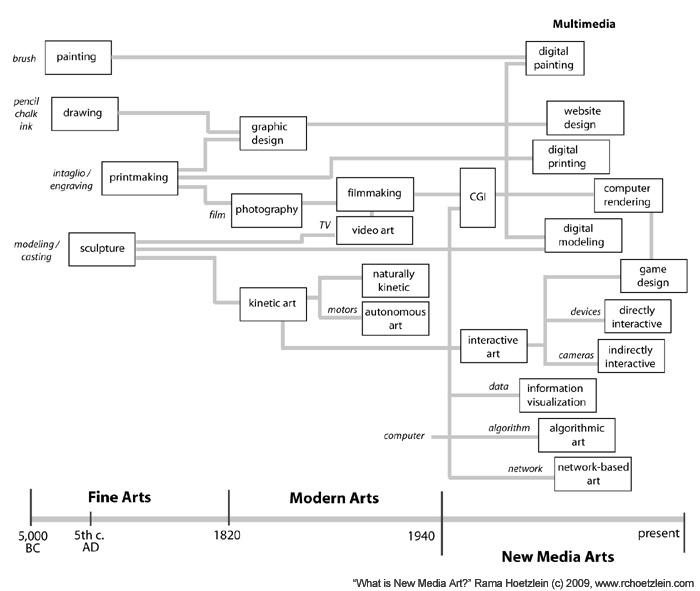
- Artist and theorist, RC Hoezlien created this visual timeline following the progression and of "New Media Art" --New Media Flow Chart Art
- Quick overview of "Understanding Media: Extensions of Man (1964)"
Look at Examples of Content Vs. McLuhan's Theory of The Medium is the message - Questions about Design. What questions do You have?
ANSWERING QUESTIONS ABOUT DESIGN WITH....DESIGN PRINCIPLES AND THEORY
How can I influence the way a design is perceived?
DESIGN PRINCIPLE: FACE-ISM RATIO 
"The ratio of face to body in an image that influences the way the person in the
image is being perceived"
``````````````````````````````
The Face-ism Ratio states that the ratio of the face to the body in an image influences the way the person in the image is perceived. Basically, close-up images of people's faces focus attention on personality and intelligence, while full or partial body shots emphasize physical or sensual attributes.
"Face-ism" as a term comes from research into gender-bias in the media done in the late 1970s. It was found that images of men in magazines, movies and other media have significantly higher emphasis on their faces as opposed to images of women. Dane Archer, Debra Kimes and Michael Barrios published "Face-ism: Five Studies of Sex-Differences in Facial Prominence" in 1978. This almost unconscious bias regarding the physical characteristics of men and women appears almost across the board in media--even in different cultures.

How do you compute the face-ism ratio? In a photograph, you divide the distance from the top of the heard to the bottom of the chin (head height) by the distance from the top of the head to the lowest part of the body that is visible (total visible height). An image without a face would have a ratio of 0.00, while an image with only a face would have a ratio of 1.00.
When you design, keep in mind the proportion of faces in your photographs, as they subtly convey emphasis on intellectual or physical characteristics. Careful cropping and use of faces in images can enhance (or detract from) your desired message.
How could you use this Principle in a Design?
WHAT ARE THE RIGHT TOOLS FOR THE JOB?
ILLUSTRATOR V. PHOTOSHOP
VECTOR V. PIXEL GRAPHICS
WEB / SCREEN V. PRINT
RGB V. CMYK
DPI V PPI

DISCUSSION of Future Project: Channeling McLuhan into Photoshop

taking cues from the medium is the message, and WIRED magazine's virtual interview with McLuhan create a photoshop composition that VISUALLY CONVEYS shows the cultural, social, personal effect or significance that that came out of this medium's introduction and widespread acceptance.
You may use a combination of 4-10 or more images, Layering, Effects, Text, Graphic and Photographic Imagery to convey your ideas..
You could consider this a visual response to
The Medium is the Massage: An Inventory of Effects is a book co-created by media analyst Marshall McLuhan and graphic designer Quentin Fiore
____________________________________________
FUTURE TOPICS:
Universal Principles of Design
re-appropriation Conceptual Collage \ Autotune the Spectacle
Retro Futurism \ looks at the present and the future through the lens of the past
